



















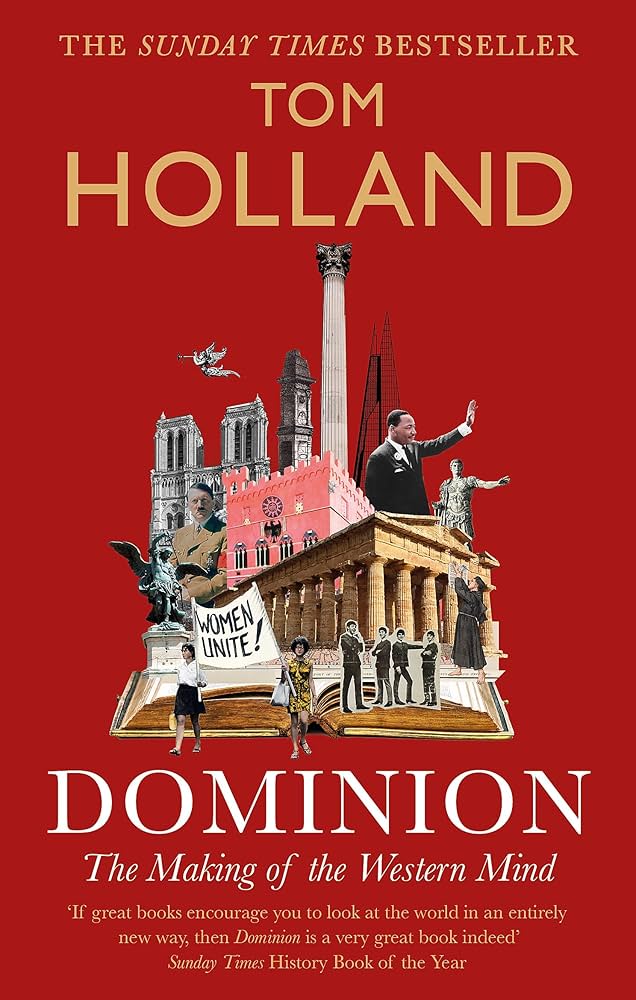


I have an interest in the history of Christianity. Most of what I knew about this subject came from online. I wanted to dig deeper though. I had heard of historian Tom Holland and had enjoyed his podcast The Rest is History, so I was eager to learn that in 2019 he had written a very thorough book on Christianity and its influence on the world. I instantly picked up a copy at Barnes & Noble with some birthday money my Grandma had kindly given me. At 624 pages, “Dominion” was easily the longest book I had read at that point.
“Dominion” starts with a foreword that explains the thesis. The book is divided into three parts, the first part is titled “Antiquity.” It begins by exploring how both the Gentiles and the Hebrews viewed God and morality, highlighting how the Christian idea of God becoming incarnate and dying a death meant only for the lowest of criminals was completely subversive to both. Building on this foundation, the rest of the “Antiquity” section focuses on the story of early Christianity and how revolutionary its moral teachings were to a society that valued strength, conquest, and power.
“Antiquity” was undeniably the hardest section for me. Holland’s writing style can be tricky to understand at first. But it also becomes clear that “Dominion” is not just a history of Christianity but a defense of its values, done by a secular humanist. Despite the book’s challenging nature, this unique angle kept me very intrigued.
The next section, titled “Christendom,” is about Christianity at its height. It illustrates the gradual changes that Christianity underwent, from the Gregorian Reforms within the Catholic Church in the 11th century to the Protestant Reformation of the 16th century. It also focuses on the imperial expansion of Christianity through events such as the Crusades and the Inquisitions.
I was finally getting the hang of Holland’s tricky prose and was really enjoying his way of telling history in a way that felt like a gripping fantasy story. At this point I was completely captivated and was very excited to read the final part: “Modernitas.”
“Modernitas“ focuses on the Enlightenment, the scientific revolution, and the various social movements that followed. It is probably the most philosophically dense section of “Dominion.” In “Modernitas,” Holland’s thesis becomes more clear: Western morality, values and beliefs, despite being seen as secular ideas, ultimately come from Christianity.
I finished the book and took a deep breath. After about two months, I had finally finished “Dominion.” I like to judge books not just by how much I enjoyed reading them but also by how they impact me and my view of the world. And “Dominion” definitely impacted me. Not only did I now have a deeper understanding of Christian history, but I also saw our modern world as a product of 2,000 years of Christian thought.