












It’s no secret to anyone who knows me that I’m a very energetic person. If you asked someone what they knew about me, they’d probably say something like, “Oh, they’re super loud!” But there’s a lot more to me than that.
I was diagnosed with ADHD (Attention Deficit Hyperactivity Disorder) when I was 7 years old. ADHD is a chronic neurodevelopmental disorder that mainly involves differences in dopamine and norepinephrine- two brain chemicals that help regulate focus, motivation, and attention. Now you might be thinking, “Oh, everyone has a little bit of ADHD! It’s not that serious!” While I understand why people say that, it’s actually a common misconception. Statements like that can unintentionally minimize the real challenges that people with ADHD experience every day.
Even when I was very young, I could tell that something about me was different. That feeling of not quite fitting in followed me for years, and honestly it still lingers sometimes. I was also a target of bullying for several years. It eventually stopped once we all got into high school and people found better things to do with their time, but experiences like that can stick with a person. Because of it, I sometimes still question whether people genuinely want to be my friend or if they’re secretly making fun of me.
Unfortunately, this kind of experience isn’t uncommon for students who are assigned female at birth and have ADHD. Due to societal expectations and gender norms, many girls are misdiagnosed- or never diagnosed at all- because they don’t show symptoms in the same way boys often do. While boys with ADHD definitely face their own struggles, girls are frequently overlooked or misunderstood. In my case, I happened to be the only girl in my class with very noticeable ADHD symptoms, which made me stand out in ways I didn’t want to.
Being a student- especially in high school- can be challenging with ADHD. Once you reach high school, grades start to matter more for your future. My GPA isn’t as high as I wish it were. While getting accepted into colleges wasn’t an issue for me, I still sometimes feel frustrated knowing that I had the potential to be an Honor Roll student but struggled because of how my brain processes things.
Recently, I learned that I’m considered “twice exceptional,” or 2e, which describes students who are both gifted and have a learning disability. Being twice exceptional can create a lot of confusion in school environments. If a student is labeled “gifted” but their disability isn’t recognized, teachers may assume they’re lazy or not trying hard enough. On the other hand, students who are labeled only by their disability may be placed in programs that underestimate their abilities.
I experienced both sides of this growing up. In early elementary school, I was sometimes placed in Special Education classrooms even though I wasn’t actually assigned there. I often felt bored because the material was something I already understood. However, I also struggled to stay focused in regular classes, so it seemed like the easiest solution at the time. Later on I was identified as a HAL (High Ability Learner), but later some teachers even threatened to remove me from the program (something they can’t even do) because I struggled in math. What they didn’t understand was that my difficulties weren’t about laziness- they were connected to my ADHD.
Thankfully, in eighth grade I received a 504 Plan, which provides accommodations for students with disabilities by adjusting the learning environment. This can include things like extended test time, alternative work spaces, and other supports that help students succeed. For me, having extra time on tests and the ability to work in quieter spaces has made a huge difference. These accommodations can also be used for exams like the ACT and even in college.
Another major challenge with ADHD is burnout. Trying to keep up with a world that isn’t really built for how my brain works can be exhausting. Many people with ADHD also experience related conditions such as anxiety, depression, sleep disorders, or chronic fatigue.
One reason burnout happens so frequently is because of something called executive dysfunction. Executive dysfunction affects skills like planning, organizing, starting tasks, and finishing them. Because of this, things like focusing, remembering information, and regulating emotions can become much more difficult. Sometimes emotions can feel overwhelming simply because so many thoughts are happening at once.
For some people with ADHD, these emotional challenges can also connect to something called Rejection Sensitive Dysphoria (RSD). RSD is when someone experiences extremely intense emotional pain from perceived criticism, rejection, or failure—even if the situation isn’t actually meant to be hurtful. Because of this, situations that might seem small to others can cause strong feelings of embarrassment, anxiety, or frustration.
These emotional responses are part of what’s known as emotional dysregulation, which is also common in people with ADHD. Emotional dysregulation can show up in many ways, including irritability, intense sadness or anger, difficulty calming down, or even feeling emotionally numb. Even though these experiences are very common, they’re not always recognized as ADHD symptoms. Emotional traits are more often associated with Autism Spectrum Disorder, and because ADHD and ASD share some similarities, one or both conditions can sometimes be overlooked during diagnosis.
Of course, ADHD doesn’t only affect academic life- it can impact personal relationships as well. I have a lot of energy, and even with medication it isn’t always something I can fully control. Because of something that is largely out of my control, I’ve had friends, romantic partners, and even family members tell me that I’m “too overwhelming,” or that I can be “embarrassing to be around.” Some people have even gone as far as ending relationships with me entirely because, as they put it, I was “too much for them to handle” or “too embarrassing to be seen with in public.”
Hearing things like that can be painful, and it’s something many people with ADHD experience. ADHD traits- like high energy, talking a lot, or strong emotions- can sometimes be misunderstood as rude or annoying by others who don’t realize that these behaviors are part of how our brains work.
What many people don’t realize, though, is that the energy people see on the outside can be exhausting on the inside. I often overwhelm myself with my own energy, which is something a lot of people never think about. Having a brain that never seems to slow down means it can be hard to truly relax or even get restful sleep, simply because there are so many thoughts moving so quickly all the time.
However, ADHD isn’t entirely negative. There are also strengths that can come with it. Many people with ADHD are highly creative, energetic, and curious. For me, creativity is a huge outlet. Whether it’s visual art, writing, or performing in marching band, I find it easy to express myself and bring energy into what I do. While it’s a disorder that won’t ever go away, I’m able to do very well in areas that other people might not be able to do as naturally. I have lots of creativity when it comes to art, whether it be visual arts, fine arts, or writing. I find myself to be almost constantly flowing with creative ideas for new drawings or paintings, and when it comes to marching band, I find it pretty easy to put a lot of character into my performances. I also find it really easy to learn a lot about random topics and absorb information when I’m interested in something- just ask me about the legendary animal that is the platypus! (They’re actually one of the only venomous mammals we know of! They’re considered monotremes because they lay eggs and are one of five species of monotreme still alive, the other four just being different species of echidna.)
But even though there’s benefits, it’s still a disorder that affects my life and the lives of over 22 million people every single day and definitely does not get the recognition or research it should have.
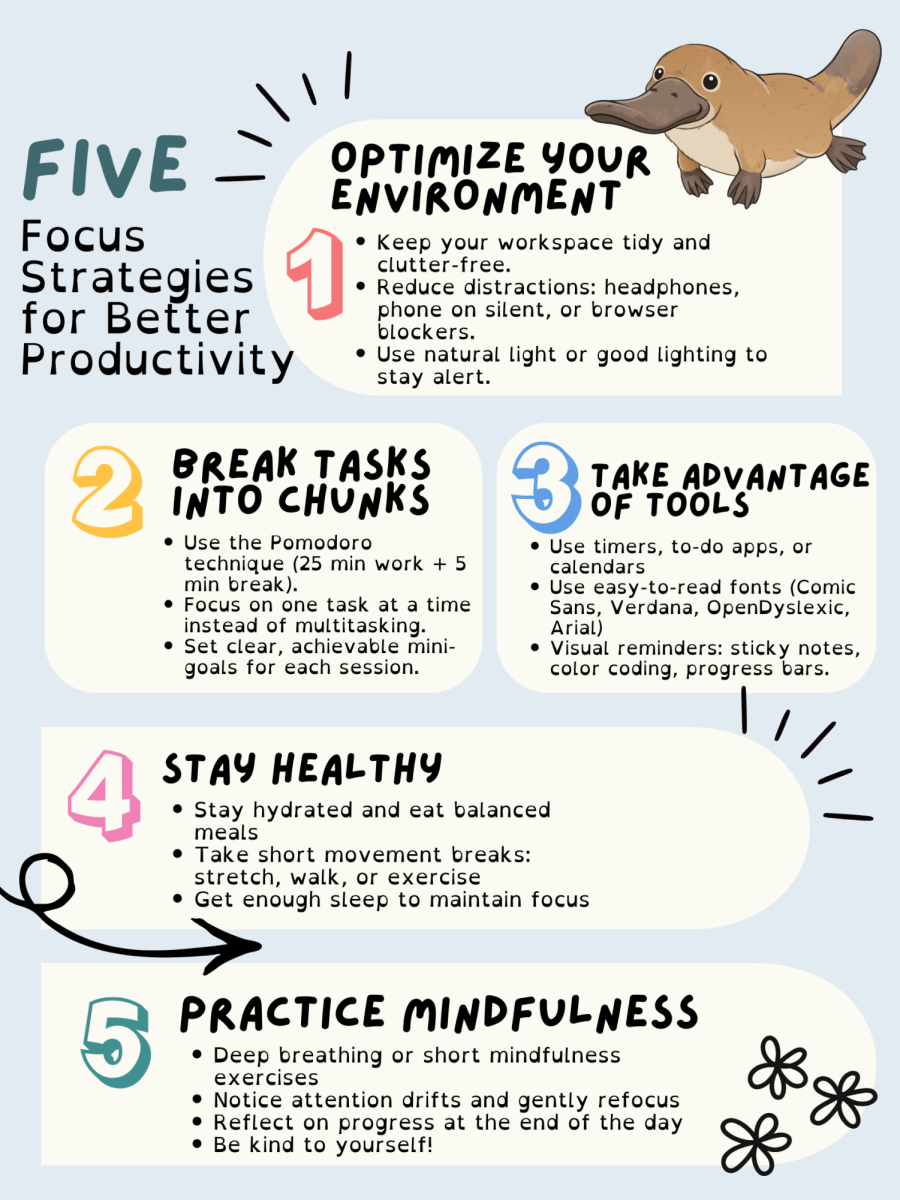
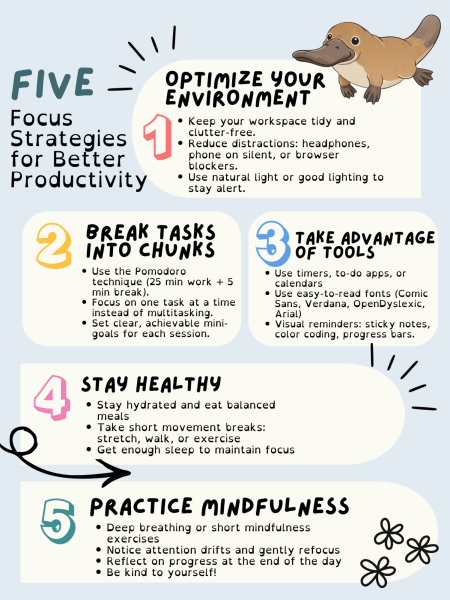
While medication can be one helpful way to manage ADHD, it isn’t the only solution, and it doesn’t work the same for everyone. Personally, I’ve been on several different medications over the years, and I’ve also had to develop many different strategies to help me stay focused and organized.
Interestingly, many of the strategies used to manage ADHD can actually help anyone. In a world full of distractions- phones, social media, and constant noise- focus can be difficult for many people, not just those with ADHD.
I hope that by sharing my experience, other students who struggle with ADHD- or even just struggle with focus, burnout, or similar challenges- can feel more understood. Everyone’s brain works differently, and that’s not something to be ashamed of. Understanding how your brain works is the first step toward finding strategies that help you succeed!