










Walking into Film Streams’ Ruth Sokolof Theater in late January to watch an obscure documentary titled “Orwell: 2+2=5”, I was shaking from the cold and absently thinking about the things I had to do when I got home: calculus, my art project, picking out my clothes, and, mostly, writing this movie review for the school magazine. I had brought a notebook with me to the theater so I could take notes as I watched, though I was going in blind and really wasn’t sure what to look out for. I figured it wouldn’t be too hard to latch onto a part of the movie to talk about at length, maybe mentioning my feelings here or there, or bits I found interesting.
The last thing I expected was for my notebook to sit, unused, during the whole of the movie – and for that movie to be stuck in my brain not just on the ride home, but for days to come.
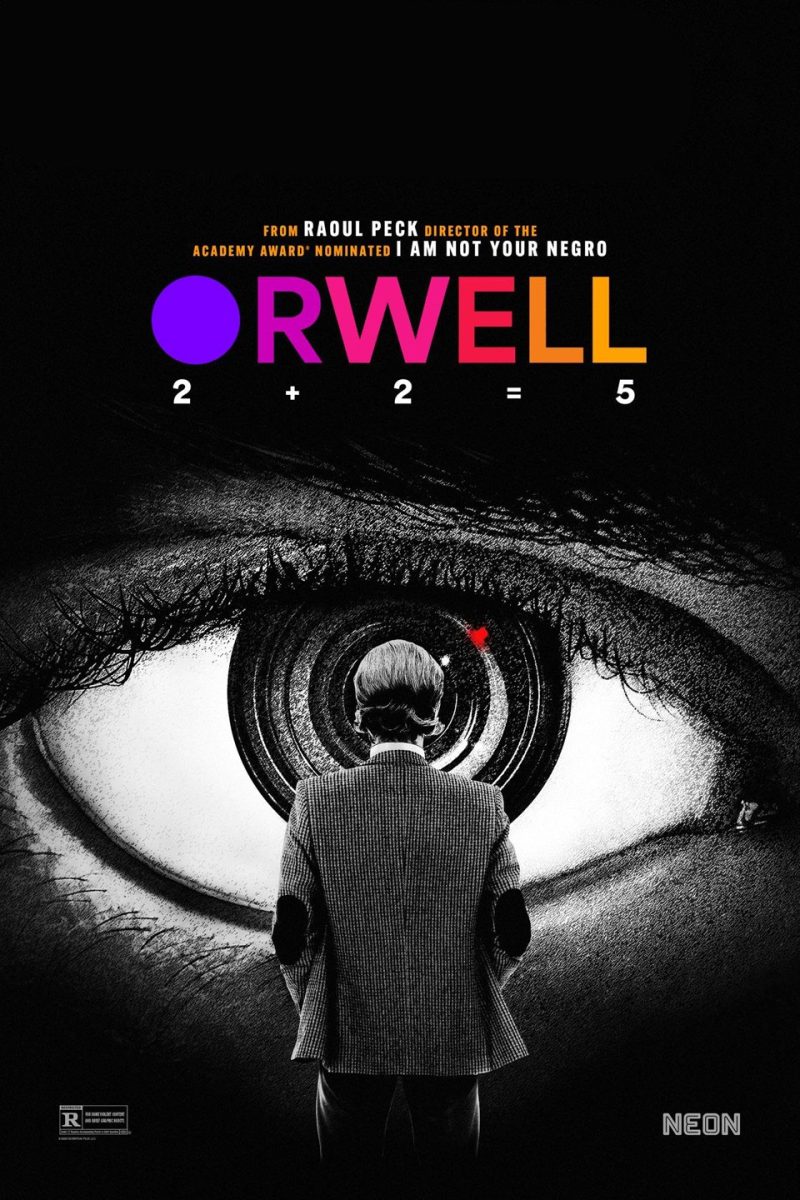
“Orwell: 2+2=5,” directed by influential Haitian filmmaker Raoul Peck, is as much about George Orwell as it is about the current world, using the author’s writing to draw parallels between dystopian fictional events and real ones, past and present.
The bulk of the Orwellian content is from the author’s ideas about totalitarian governments, drawing excerpts from his letters and novels. His novel “Animal Farm” warrants mention, but what comes up most persistently, and even helped name the movie, is his book “1984.” Almost any student of high school English knows of that dystopia, or at least has heard about how “Big Brother” is always watching.
“1984” serves as the vehicle for this documentary’s somewhat disjointed narrative; and with a two-hour running time, it is definitely a hefty watch. The movie is split into three parts named after the ideals in “1984”: “War Is Peace,” “Ignorance is Strength,” and “Freedom Is Slavery.” Each aspect presents modern historical examples to go along with it, of government actions for the sake of “peace,” people proud in their ignorance, and the strange ways things are twisted to seem like freedom.
As I watched the film lay out its premise, I waited for some kind of message, or call to action, but it seems this wasn’t intended to tell us what to do about the world we live in; it simply shows it to us through Orwell’s cynical, but in some concerning ways truthful, lens on government.
For me, “Orwell: 2+2=5” was a dense watch and a difficult one, especially considering my tendency to shift focus to the smaller picture of my own day-to-day life when subjects or circumstances become overwhelming.
Politics are notoriously volatile, and hard to swallow; the subject has weighed me down heavily in the past, and even now – maybe especially now, after watching this. I get swept up in my own emotions, and this documentary brought so many of my fears to the surface. That might not sound like a good thing, but I honestly consider it a necessary one.
It took an emotional toll seeing so much all at once from this documentary, and grappling with exactly what it was trying to drive home; but it made me realize that fear sometimes plays an important role.
In the past, being scared has made me look away from a lot of horrible things, but I think it’s even scarier to think of what following blindly forward might do to me and the world around me.
In Orwell’s “1984,” the Prole characters were so unconscious of what was happening that they never thought to rebel, or notice the conditions they were living in. I feel it’s easy to fall into that mindset, of not knowing or seeing things in order to protect oneself. This documentary pushed me into realizing how harmful that can be, because one’s unawareness can be taken advantage of.
I wasn’t called to action by this documentary, but seeing it motivated me to engage more with the difficult parts of now. It also brought me to a more unsettling fear: For me and people my age, there’s only so much we can do, if anything, about the world we live in. Things are largely out of our control, and that can be just as hard to deal with as seeing bad things happen.
I don’t think there’s an easy answer or remedy that tells me what I should do, but just having this type of discussion seems powerful in itself.
After the screening at Ruth Sokolof Theater, audience members participated in an hourlong discussion led by, Dr. Clif Mason, dean of the College of Arts and Sciences at Bellevue University. As the dean spoke about the documentary, he picked out quotes from a copy of “1984,” expanding on certain directorial decisions. It was Mason who first made the connection about the Proles, describing them as being in an unaware state despite holding the power to resist.
Being very affected by the movie, I dedicated my time to listening during this part, hearing younger and older people alike reflecting on what we’d watched, linking it to recent events, or making comments about their own lives. In the theater that night, I got the impression that these topics don’t get easier to manage, no matter how old you might be; there was comfort in hearing that honesty from people.
The documentary was a new experience for me, not only in location, but in content, in a way that was jarring and frightening. At the same time I was feeling all those things, I also realized the significance of that impact. The documentary felt like being splashed with water, or shaken awake from a coma, but being grateful after all that sleeping to be conscious again.
I don’t wish to embellish my thoughts on the movie, but I know it might not sound appealing based on how emotional it made me. Despite that, I actually do recommend this documentary to anyone who wants to watch something very carefully put together – to learn about Orwell, as well as the events around us, in a raw and candid way.
“Orwell 2+2=5” is available for rent and purchase on Amazon Prime Video. I encourage viewers to keep their minds open for a thought-provoking experience while watching, and ready themselves for the possibility of needing to rewatch once, maybe twice, to fully comprehend everything they will take in.