







For Titan Theatre and Journalism students, finals week started with a unique opportunity to visit “Suspended in Time: Still Lives and Magic Realism” at Aksarben Village’s Samuel Bak Museum: The Learning Center, which houses the works of 92-year-old Holocaust survivor and lifelong artist Samuel Bak.
With upcoming theatre productions “The Diary of Anne Frank” March 26-28 and “James and the Giant Peach” April 30-May 2, Theatre Tech and Play Production students took this chance to learn about themes of growth and resilience through art.
Bak’s own life parallels the experiences Anne Frank recorded in her famous diary, and his art features symbols such as pears, teacups, tables, and concrete to represent humanity and a personal history marred by the Holocaust.
Director of Education Kati Larson welcomed students to The Learning Center as they sat down to watch a video recently filmed of Bak, who was born in Vilna, Poland, but has resided in Boston since 1993. In the video, the artist shares stories of his survival and the loss of his father as he and his mother spent time in a Nazi-controlled ghetto and in hiding at a convent, where Bak honed his art at the age of 9.
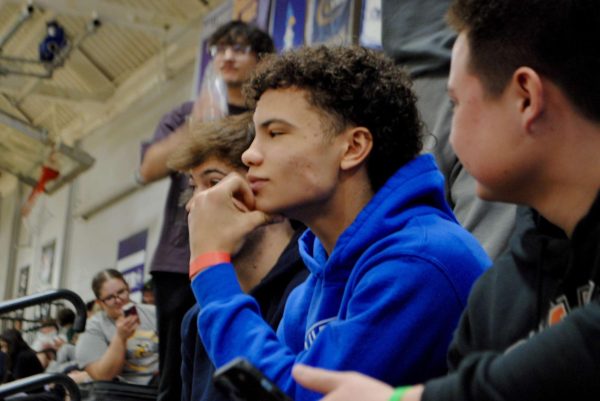
The Holocaust is a heavy subject for any student, but Bak’s work invites conversation, connection and hope for people of all ages, Larson said. Students had the opportunity to walk around the exhibition, take notes, and sketch their own ideas. Journalism students snapped photographs, conducted interviews and composed reviews reflecting on Bak’s work.
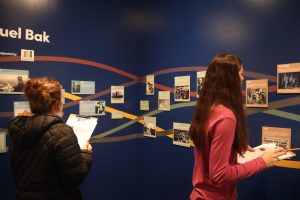
“You’re all coming from different perspectives and different life stories, but collectively together, the conversations can be universally human,” Larson said. “We all have the same wants and needs and what we hope for. I think Sam’s paintings are so hopeful, and we can collectively have those conversations that we have in common – and we find more commonalities than differences.”
Chief curator Alexandra Cardon said Bak chose Omaha because “he was hoping to bring to this area of the country a space for conversation.”
“We’ve had very difficult conversations within this museum space about … definitions of genocide, about discrimination, about cycles of hate,” Cardon said, “but we’ve also had really beautiful conversations of reconciliation.”
After a visit to Omaha in 2019, where Bak met local university and high school students, the artist “realized this is a special place, and it is a place that was willing and hungry for the conversations that he was bringing through his artwork,” Cardon said.
“Something that’s really cool is that Sam is an amazing painter. The way he moves paint around, how he blends his past as an abstract artist,” the curator said. “You can really see that in his depictions of nature when you get close up, the whole scene falls apart, and then you pull back and you have this intense realism.”
The Learning Center is free and open to the public Wednesday-Sunday. It hosts academic visits on Mondays and Tuesdays. The current exhibition, “Suspended in Time: Still Lives and Magic Realism,” which also features the work of visiting artists Ori Gersht, Stephen Namara and Fidencio Fifield-Perez, will end Dec. 21. The Museum will be closed Dec. 22 through Jan. 20 for exhibition deinstallation and reinstallation. It will reopen with a new Bak-centered exhibition on Jan. 21.